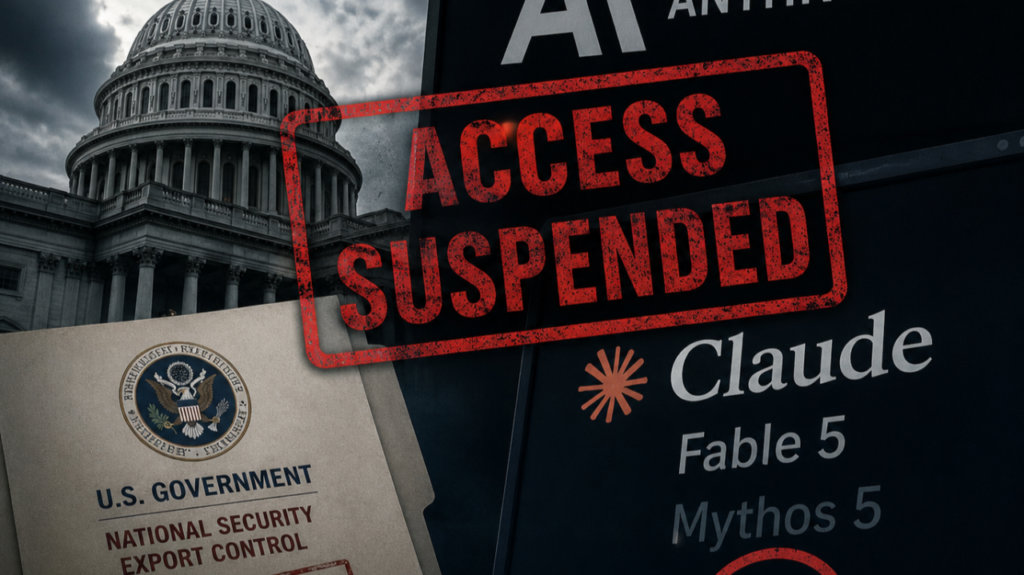
Anthropic has once again suspended access to its advanced AI models, Claude Mythos 5 and Claude Fable 5, following fresh restrictions imposed by U.S. authorities over national security concerns. The development has intensified the global discussion around AI governance, export controls, and the responsible deployment of frontier artificial intelligence models.
The temporary suspension comes at a time when governments and technology companies are working to balance rapid AI innovation with the need to prevent misuse of increasingly powerful language models.
Why Were Claude Mythos 5 and Fable 5 Suspended?
According to reports, U.S. authorities introduced additional restrictions on foreign access to Anthropic’s latest AI models, citing concerns that advanced “jailbreak” techniques could bypass built-in safety mechanisms. The directive prompted Anthropic to temporarily disable access while complying with government requirements. The company has said it disagrees with parts of the ruling but will continue working with regulators as the issue is reviewed. ([The Times of India][1])
The move highlights the growing scrutiny surrounding advanced AI systems that possess sophisticated reasoning, coding, and problem-solving capabilities.
AI Safety Takes Center Stage
The latest restrictions underscore how AI safety has become a major priority for governments worldwide. As generative AI evolves, policymakers are increasingly concerned about preventing the misuse of highly capable models in sensitive sectors.
Technology companies are also strengthening responsible AI practices by improving model safeguards, expanding security testing, and investing in transparency measures to reduce potential risks.
For businesses and developers, the incident serves as a reminder that compliance and AI governance are becoming essential parts of deploying advanced AI solutions.
What This Means for the Global AI Industry
The suspension could have broader implications for the artificial intelligence industry. Experts believe the decision may influence future regulations governing frontier AI models, particularly those with advanced coding, cybersecurity, and autonomous reasoning capabilities.
The development also raises questions about how governments should regulate cutting-edge AI without slowing innovation. As countries race to establish leadership in artificial intelligence, policymakers must balance technological progress with national security and public safety.
Impact on Businesses and Startups
Technology startups, software companies, and enterprise AI users closely monitor regulatory developments because they directly affect product availability, international collaboration, and AI adoption strategies.
Businesses building AI-powered applications may increasingly diversify across multiple AI platforms rather than relying on a single provider. The incident also reinforces the importance of secure AI deployment, compliance planning, and responsible innovation for organizations integrating large language models into their operations.
Why This Matters for Pakistan’s Tech Ecosystem
For Pakistan’s growing technology sector, the situation offers valuable lessons. As local startups expand their use of artificial intelligence in fintech, healthtech, edtech, and enterprise software, understanding global AI regulations will become increasingly important.
Pakistan’s IT companies and AI developers should prioritize ethical AI development, cybersecurity, data governance, and regulatory compliance to remain competitive in international markets.
The evolving global AI landscape also presents opportunities for local innovators to build trustworthy AI solutions that align with emerging international standards.
The Future of AI Regulation
The suspension of Claude Mythos 5 and Claude Fable 5 reflects a larger shift toward stronger oversight of frontier AI technologies. Governments, technology firms, and research organizations are expected to collaborate more closely on developing common frameworks for AI safety, transparency, and accountability.
As artificial intelligence becomes more powerful, future regulations will likely focus on reducing security risks while supporting innovation that benefits businesses, governments, and society.
Final Thoughts
Anthropic’s latest suspension of Claude Mythos 5 and Claude Fable 5 demonstrates how AI regulation is rapidly becoming a defining issue for the global technology industry. While the restrictions are temporary, they highlight the increasing importance of AI governance, cybersecurity, export controls, and responsible innovation.
For Pakistan’s startup ecosystem, technology companies, and digital entrepreneurs, staying informed about international AI policy trends will be critical. As artificial intelligence continues to reshape industries, organizations that combine innovation with strong security and ethical standards will be best positioned for long-term success. The source of this news is Techinpakistan.